Two blades can both read 60 HRC on the bench and behave nothing alike once they are bolted into a shear. We see it most on demolition and mobile machines: the hardness certificate is clean, and the edge still chips the first time the jaw meets something it should not have hit. HRC only tells you how well steel resists being dented or scratched. It says nothing about how much energy the blade soaks up before a crack runs. How much impact energy a shear blade can absorb before chipping is a separate number, measured in joules on a Charpy test, and it decides whether a 58–62 HRC edge survives mixed scrap.
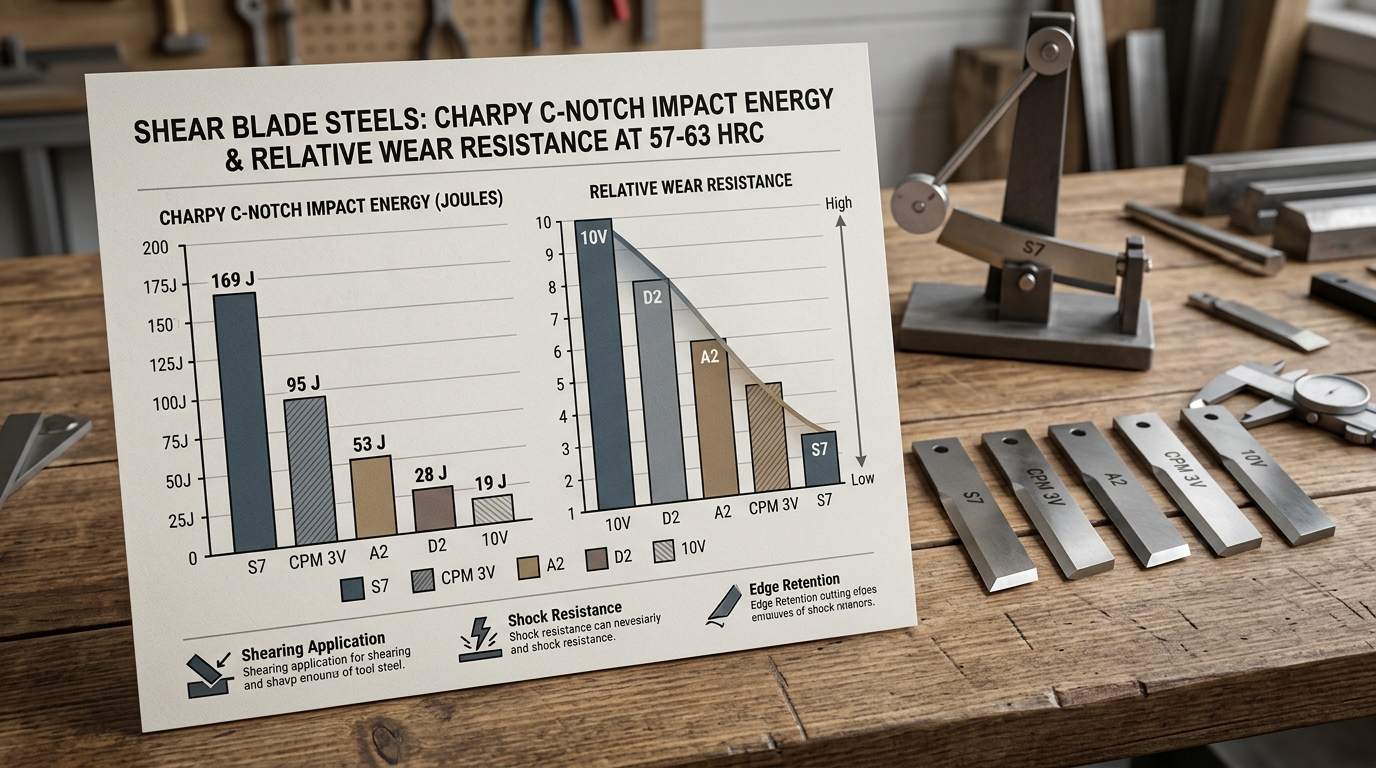
On the same manufacturer test, D2 at 60 HRC takes about 28 J while S7 at 57 HRC takes about 169 J. Six times the impact energy sits behind three HRC points. That is why a hardness figure alone is not a blade specification. When the feed is full of surprises, start with demolition shear blade toughness and work back to the grade, not the other way round.
Key Takeaways
- Hardness is not toughness. At 60 HRC, D2 absorbs about 28 J in a Charpy C-notch test; S7 at 57 HRC takes about 169 J.
- Wear runs the other way. The same datasheet puts S7 at 1 and D2 at 3–4 on relative wear resistance.
- Charpy numbers rank grades; they do not predict service life. Notch shape, specimen direction, test temperature and temper all move the result.
- C-notch and V-notch values are not interchangeable — never compare a 28 J C-notch figure with a V-notch figure from another mill.
- Write the test conditions into the enquiry, not a bare "J" into the purchase order.
What Does a Charpy Number Actually Tell You About a Blade?
A Charpy test swings a pendulum at a notched specimen and measures the energy, in joules, that the steel absorbs before it breaks. What a charpy c-notch value means for tool steel is a ranking of how a grade handles a sudden blow at a given hardness — nothing more. The table below is one comparison series published in Crucible S7 and Hudson D2 datasheets, all C-notch, all at the hardness each grade was tempered to:
| Grade | Hardness (HRC) | Charpy C-notch (J) | Relative wear resistance | Where it fits on a shear |
|---|---|---|---|---|
| S7 | 57 | 169 | 1 (baseline) | Demolition, mobile shear, punches |
| CPM 3V | 60 | 95 | 7 | Shock plus abrasion, premium inserts |
| A2 | 60 | 53 | 2–3 | General cold shear, moderate shock |
| O1 | 60 | 41 | Not rated in this series | Small blades, low-volume work |
| D2 / Cr12MoV | 60 | 28 | 3–4 | Clean plate, steady feed, mixed scrap |
| M2 | 62 | 27 | 8–10 | High wear, low shock |
| 10V | 63 | 19 | 90 | Extreme abrasion, no impact |
Read that as a charpy impact energy comparison for D2 and S7 blades, not a set of acceptance limits. D2 and M2 sit within 1 J of each other at 60–62 HRC, yet their wear numbers differ by a factor of two or three. S7 buys six times the impact energy and gives up most of its abrasion life to do it. H13 is often quoted near 237 J, but that figure is estimated from V-notch data at 45 HRC and does not belong in this column. These are small laboratory specimens, not finished blades — a shredder blade impact grade should be chosen by the shock the rotor actually sees, then confirmed on the machine.
Why Do Two Blades at 60 HRC Chip Differently?
Because hardness measures resistance to a slow, shallow indent, while chipping is a fast crack. Why 60 HRC shear blades chip on mixed scrap comes down to what sits inside the steel: D2 is packed with hard chromium carbides that stop abrasion but give a crack an easy path, while S7 has a leaner, tougher matrix that blunts it. The bands below use only the anchor values from the table above and are indicative selection guides, not lab measurements — confirm them against your own feed and drawing:
| Duty on the shear | Shock level | Datasheet J band (indicative) | Grade and hardness that fits | What you give up |
|---|---|---|---|---|
| Clean plate, steady guillotine cuts | Low | 19–28 J | D2 at 58–62 HRC | Shock tolerance on tramp metal |
| Mixed scrap, light baling wire | Medium | 41–53 J | A2 at 60 HRC, or D2 tempered back to 56–58 HRC | Some edge life on abrasive feed |
| Demolition, rebar, unshreddables | High | 95–169 J | S7 at 54–58 HRC, CPM 3V near 60 HRC | Wear resistance (1 vs 3–4 on the same scale) |
| Hot bar and hot shear sections | Heat plus shock | Not comparable at room temperature | H13 at 48–52 HRC | Cold abrasion resistance |
Balers sit awkwardly in the middle. Baling wire is abrasive enough to punish an S7 edge, but a tight bundle can still land like a hammer. That is why baler shear blade shock load is usually handled by a supported bevel and a slightly tempered-back D2 rather than by jumping to a shock grade. Minimum impact toughness for demolition shear blades is a different conversation entirely — on an excavator you spec for the worst thing that can enter the jaw, not for the average bundle.
What Should You Put on the Test Report Instead of a Bare Number?
A joule figure without its test conditions is close to meaningless. What test conditions to specify for blade impact energy is the practical question, and these are the six fields that move a Charpy result enough to change a grade decision:
| Field to agree | Why it moves the number | What to write on the enquiry |
|---|---|---|
| Notch geometry | C-notch and V-notch results differ several-fold on the same steel | "Charpy C-notch, same method as the grade datasheet" |
| Specimen direction | Transverse readings run lower than longitudinal in rolled bar | "Longitudinal, from the same bar as the blade" |
| Test temperature | Toughness falls in a cold yard or a winter shift | "20 C", or "-20 C" for cold-climate service |
| Temper and HRC at test | Tempering back 2–3 HRC can lift impact energy sharply | "60 HRC, double tempered, state the temper temperature" |
| Specimen size | Subsize specimens do not give comparable joule values | "Full-size 10 x 10 x 55 mm" |
| Heat / batch | Cleanliness shifts toughness more than the grade name does | "Same heat number as the delivered blade" |
Most blade buyers will never run a Charpy test, and they do not need to. But blade impact test report requirements are still a useful question to ask a supplier: if someone quotes "high toughness" and cannot say which notch, which direction and at what HRC, that silence tells you more than the number would. Agree the conditions before writing an impact requirement into a purchase specification.
FAQ
Why does a hardness certificate not tell you how tough a blade is?
Because a Rockwell tester only measures resistance to a slow indent, not resistance to a fast crack. Two grades at 60 HRC can have very different carbide content, grain structure and temper history. In the Crucible/Hudson C-notch series, D2 at 60 HRC absorbs about 28 J and A2 at 60 HRC about 53 J — nearly double, at the same hardness. A certificate that says 60 HRC tells you nothing about which of those two you are holding.
What is a good Charpy value for a shear blade?
There is no universal pass mark. On the C-notch datasheet scale, 19–28 J is normal for high-wear cold-work grades on clean plate, 41–53 J suits moderate shock, and 95–169 J is where shock-resisting grades such as S7 and CPM 3V sit. Match the band to the worst impact your feed can produce, and never compare a C-notch number with a V-notch number.
Is S7 better than D2 for mixed scrap shearing?
Only when shock is the failure mode. S7 at 57 HRC absorbs about 169 J against 28 J for D2 at 60 HRC, but its relative wear resistance is 1 against 3–4, so it rounds off faster on abrasive feed. For steady mixed scrap most shops stay with D2 and temper it back 2–3 HRC; S7 earns its keep on demolition and mobile shears that hit rebar and unshreddables.
Can I put an impact energy requirement on the purchase order?
Yes, but only together with the test conditions: notch type, specimen direction, test temperature, temper and HRC, specimen size, and the heat number. A bare "minimum 50 J" is not enforceable because a different notch or specimen direction can change the reading several-fold. Agree the method first, then the number.
Does tempering back 2 HRC really help on mixed scrap?
Usually yes on shock-loaded work, and it is the cheapest change available. Dropping a D2 edge from 60–62 HRC to 56–58 HRC gives up some abrasion life but moves the grade toward the tougher part of its temper curve. It is not a substitute for a shock-resisting grade on demolition shears, and the exact gain depends on the temper temperature — ask the mill for the curve rather than assuming a fixed joule gain.
A hardness number is easy to quote and easy to check, which is why it ends up alone on so many drawings. Impact energy is harder to measure and harder to compare, but it separates a blade that wears down from one that breaks. Shear blade grade and hardness specification should travel with the shock level of the job: bring the feed, the worst-case impact and the drawing when you ask for a quote, and those three will tell a supplier more than a lone 60 HRC ever could. See the full range at GOOD-KNIFE or send us your material list for a like-for-like recommendation.